Work backwards from preparation time
If your team starts at one in the morning, it needs an order baseline before arriving. Set cutoffs around purchasing, production times and delivery rounds. An example time in a demo is not a substitute for your own constraints.
Make regular requirements easy to renew
A hotel often returns to a few products: croissants, bread and pastries. Showing those products makes ordering easier. Customers use previous orders to plan their next purchase. They choose and confirm each new order; regular habits do not start an automatic subscription.
Separate ordering from editing
Ordering around the clock does not mean changing any order at any time. Explain delivery dates and applicable deadlines. Once the planned lock takes effect, exceptional requests need a process understood by your team.
Prepare totals, then allocate
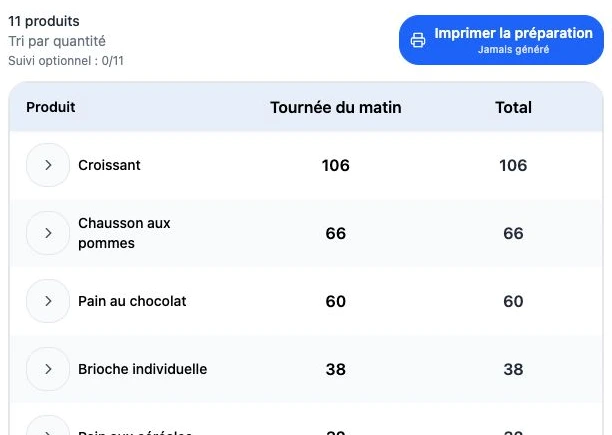
The overall view shows how much to prepare of each product. Customer detail supports packing and handover. Count pieces and kilograms separately. Check options such as sliced bread: they affect the work even when the underlying product is the same.
Close the loop in the morning
Delivery notes travel with the packages. Drivers confirm handover and staff can find the order status. Review missed orders, late changes and re-entry work afterwards. Those observations show what is improving and help you adjust the rules with your team.
Example day — adapt the times
A clear rule before the night shift.
- 5 pm
The hotel confirms 40 croissants; the restaurant confirms 24 bread rolls.
- 6 pm
The cutoff closes ordinary edits for the next day.
- 1 am
The baker reviews the summary; the team then allocates by customer.
- 6 am
Delivery notes accompany the round; the driver confirms handovers.
A rule to share with customers
For delivery tomorrow morning, confirm your order before 6 pm the day before. You can edit it in your space until that cutoff. After 6 pm, contact your usual manager; changes need their confirmation. Each new delivery requires a confirmed order.
If the hotel asks for ten extra croissants at 8 pm, the manager checks production capacity before accepting. These times are an example, not a rule imposed by ArtisFlow.